Working Genius in Healthcare Leadership: Building Healthier, High-Performing Teams
Healthcare leadership today sits at the intersection of immense complexity and profound vocation. Regulations, technology, demographics, reimbursement, litigation, fraud, and shifting financial realities collide with a simple, human truth: most people in healthcare are not just doing a job — they are living a calling.
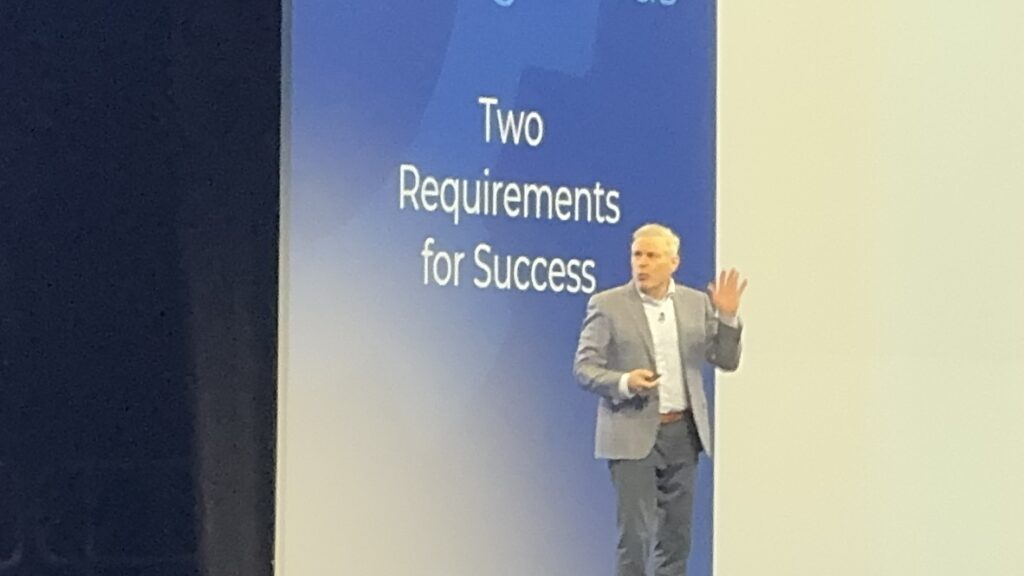
In his keynote, Patrick Lencioni argued that in this environment, it is not enough for healthcare organizations to be smart. To thrive, they must also be healthy — and a powerful way to get there is by understanding the Six Types of Working Genius.
This article distills that message and translates it into practical insight for healthcare leaders.
Smart vs. Healthy: The Two Requirements for Organizational Success
Lencioni described two foundational requirements for any successful organization:
- Smart
- Strategy
- Finance
- Operations
- Technology
- Decision science and analytics
These are the “hard” capabilities we typically emphasize in business schools, consulting, and management literature. They’re critical — especially in healthcare, where the “smart” side is extraordinarily complex and ever‑changing.
- Healthy
- Minimal politics
- Minimal confusion
- High morale (in a real, not “touchy‑feely” sense)
- High productivity
- Low turnover of good people
Healthy organizations are places where people are energized to come to work, know what’s going on, trust each other, and want to stay.
Lencioni pointed out that most CEOs will admit, if pressed, that what keeps them up at night is not strategy or finance but the “soft stuff” — culture, conflict, politics, disengagement. And yet, because it’s harder to measure, they often focus where the “light is better”: on the smart side.
His central claim: Healthy organizations get smarter over time. Smart but unhealthy organizations lose their way.
In healthcare, where complexity is high and stakeholders are many, organizational health is a competitive and moral imperative.
From Personal Frustration to Universal Insight
Lencioni’s “Working Genius” model began not as a theory, but as an attempt to explain his own inconsistent experience of work: from deep excitement, to sudden grumpiness, back to excitement again — all in the same day, with the same people and company he loved.
Challenged by a colleague who asked, “Why are you like that?” he went to a whiteboard and started mapping patterns of work that gave him energy versus those that drained him. Over time, he and his team refined this into a model of six distinct types of work that show up in every project, initiative, and organization.
They then built a 12‑minute assessment, tested it across many people and organizations, and discovered something powerful:
- People are not simply “good” or “bad” performers.
- Many are miscast in roles that do not align with their God‑given, innate “genius”.
- When a person’s job is dominated by tasks in their Working Frustrations, performance, engagement, and confidence erode — sometimes to the point of burnout or exit.
- Small shifts — reassigning responsibilities, redesigning roles, or rebalancing teams — can yield dramatic jumps in morale and productivity.
One healthcare leader shared that after applying Working Genius to her team structure, they tripled their productivity in a year simply by reshuffling who did what — not by hiring or firing.
The Six Types of Working Genius
The Working Genius model describes six types of work that show up in any endeavor — from opening a new hospital, to launching a program, to redesigning a care pathway, to planning a family vacation.
Each person has:
- 2 Working Geniuses – where they are naturally gifted; work in these areas gives energy.
- 2 Working Competencies – they can do this work reasonably well, but it neither drains nor deeply energizes them.
- 2 Working Frustrations – work here drains energy quickly and, if prolonged, leads to dissatisfaction or failure.
Lencioni uses a simple metaphor:
- Genius: coffee in a Yeti mug – energy stays hot and strong a long time.
- Competency: coffee in a regular cup with a lid – holds for a while.
- Frustration: coffee in a cup with a hole in the bottom – drains fast.
Here are the six types:
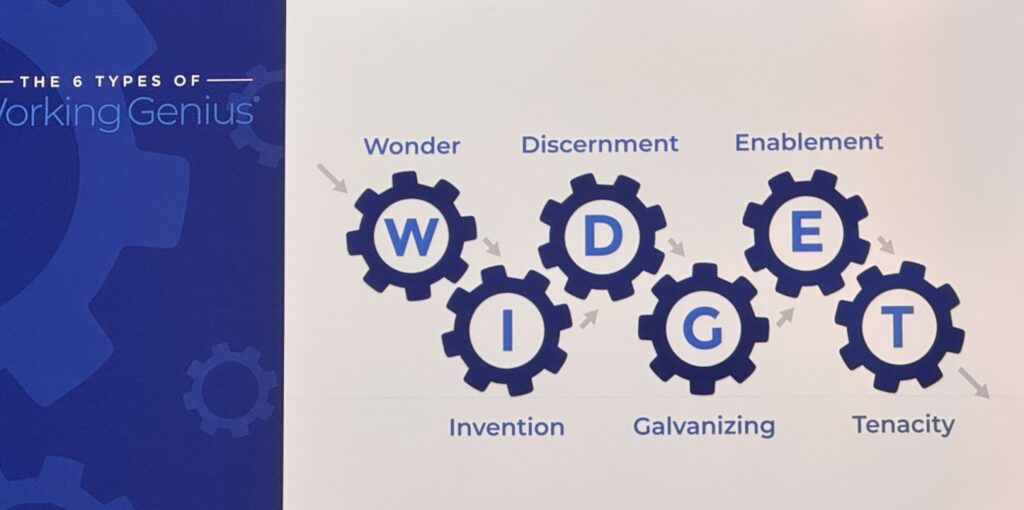
1. Wonder (W) – The Genius of Questioning
People with the genius of Wonder:
- Ask big, foundational questions: “Is this the best we can do?” “Why are we doing it this way?”
- Reflect on whether the current reality is good, right, or complete.
- Notice gaps, possibilities, and areas for improvement.
They are often misunderstood as:
- Distracted
- Not “on board”
- “Overthinking” or “daydreaming”
Yet every meaningful improvement begins with Wonder. In healthcare, this might be:
- “I wonder if our patient experience could be much better.”
- “I wonder if these readmissions are really inevitable.”
Suppressing Wonder means silencing the earliest signal that change is needed.
2. Invention (I) – The Genius of Creating
People with the genius of Invention:
- Love to solve problems from scratch.
- Generate new ideas, models, tools, and approaches.
- Thrive when given a blank slate and a challenge: “How might we…?”
These are your natural innovators. For Lencioni, this is a core genius; he wakes up inventing new frameworks, books, and ideas.
In healthcare, Invention might show up as:
- Designing a new care model
- Creating a novel staffing approach
- Reimagining patient flow or communication processes
Wonder and Invention together form Ideation – seeing what could be and designing potential solutions.
3. Discernment (D) – The Genius of Judgment
People with the genius of Discernment:
- Have strong instincts and intuition about ideas and decisions.
- Quickly “sense” whether something will work or not, often without being able to fully explain why.
- See patterns in complex, multi‑variable situations.
This is not mystical; it is fast, holistic judgment developed through experience and a particular kind of wiring.
In healthcare, Discernment often appears in:
- Clinicians or leaders who can rapidly prioritize, triage, or diagnose situations beyond what data alone shows.
- Team members whose feedback on proposed strategies or initiatives is almost uncannily accurate.
Discernment is crucial for vetting ideas before large investments of time and money.
4. Galvanizing (G) – The Genius of Rallying
People with the genius of Galvanizing:
- Love to rally, inspire, and push others to action.
- Are energized by getting people moving and keeping momentum alive.
- Naturally take the microphone, call the meeting, send the follow‑up, and say, “Let’s go!”
Without Galvanizing:
- Great ideas stall.
- Teams get excited once, then drift back into old patterns.
- Change efforts struggle to sustain energy.
In healthcare, Galvanizing is critical when:
- Rolling out new clinical protocols
- Driving adoption of a new EMR feature
- Leading culture or safety initiatives
Lencioni shared that repeatedly having to galvanize, when it was not his natural genius, left him drained and grumpy. When he identified someone on his team who loved galvanizing and shifted that responsibility, both of them — and the organization — benefited.
5. Enablement (E) – The Genius of Supporting
People with the genius of Enablement:
- Love to help others succeed.
- Say “yes” easily, often before the request is even fully stated.
- Provide assistance, resources, presence, and encouragement at just the right time.
They are not simply “nice.” Enablement is a true work genius:
- Responding to others’ needs
- Making others’ work possible
- Being the “glue” that holds execution together
In a hospital, this looks like the nurse who answers the call light with genuine joy for the third time in 15 minutes, or the colleague who instinctively steps in to help another department under pressure.
Without Enablement:
- People feel alone and unsupported.
- Initiatives die in the gap between intention and execution.
6. Tenacity (T) – The Genius of Finishing
People with the genius of Tenacity:
- Are determined to drive tasks to completion.
- Love clear outcomes, measurable results, and finished checklists.
- Are dissatisfied when things remain half‑done or ambiguous.
Tenacity is vital in healthcare, where:
- Regulatory requirements must be fully met.
- Projects have hard deadlines.
- Quality and safety improvements must be not just designed, but implemented, audited, and sustained.
Without Tenacity:
- Projects linger “80% complete.”
- Strategic plans never fully materialize.
- People start many things and finish few.
The Three Stages of Work
The six types organize naturally into three stages that appear in every initiative:
- Ideation (W + I) – Asking big questions and creating solutions
- Activation (D + G) – Judging ideas and rallying people behind the best ones
- Implementation (E + T) – Supporting and driving work to completion
Breakdowns happen when:
- A team is strong in one stage and weak in others.
- For example, a team may have great designers (W + I) and strong executors (E + T), but no one to discern and galvanize (D + G), so ideas don’t get properly vetted or sustained.
One global brand Lencioni mentioned had plenty of design talent but lacked D and G — so excellent product ideas stalled in the gap between concept and market.
For healthcare leaders, the question becomes:
Where in this chain is my team consistently struggling? Is it ideation, activation, or implementation?
Initiating vs. Responsive Geniuses
Another helpful lens is to distinguish between:
- Initiating Geniuses – tend to start things, challenge the status quo, or push for action.
- Responsive Geniuses – tend to respond to others’ needs, questions, or directions.
Across the top of the model (W, D, E), some geniuses are more responsive by nature — they react to something presented (a situation, an idea, a need). Others are more naturally initiating (for example, W and I often initiate new thinking).
Recognizing this matters because:
- If someone’s two geniuses are both responsive, demanding that they be the primary initiator of change may frustrate them and disappoint you.
- Conversely, highly initiating geniuses may struggle in roles that require primarily reactive, support‑driven work.
Aligning role expectations with how people are wired to engage work not only improves performance but also lowers burnout and turnover.
When Misalignment Looks Like Poor Performance
Lencioni shared stories that will sound familiar to many healthcare leaders:
A high‑potential employee heading into a negative performance review, expecting to be criticized or demoted. After taking the Working Genius assessment, he and his leaders realized:
- His role was heavily weighted in his Working Frustrations.
- Another part of the organization had a role that perfectly matched his Geniuses.
- Instead of being fired, he was re‑deployed and effectively promoted, moving from “struggling performer” to thriving contributor.
A CEO nearly fired his best sales executive because she couldn’t design a new sales strategy when the market shifted. After mapping her Working Genius:
- They saw she was exceptional at execution and follow‑through, not strategy invention.
- They brought in someone with strong Invention and Discernment for the strategy work; she continued to excel in her genius.
- The organization kept a top performer and avoided a major talent mistake.
How many times in healthcare do we:
- Lose a great nurse who is miscast as a manager?
- Burn out an outstanding clinician by pushing them into a role that demands constant galvanizing or ideation?
- Criticize someone for poor performance in a job that is simply a bad fit for their genius?
Working Genius offers a language and framework to separate character and commitment from fit and wiring, so leaders can make wiser decisions about hiring, promotion, and restructuring.
Practical Applications for Healthcare Leaders
1. Role Design and Job Fit
Before hiring or restructuring, ask:
- What types of work (W, I, D, G, E, T) does this role truly require most?
- Are there any geniuses that are essential?
- Are there any frustrations that, if dominant in a candidate, would make them miserable here?
Then, when assessing candidates or current team members:
- Compare their Working Genius profile to the demands of the role.
- Avoid placing people in jobs dominated by their Working Frustrations.
- Where perfect alignment isn’t possible, ensure they at least get regular opportunities to live in their Geniuses.
2. Team Composition
Look at your leadership or project team and ask:
- Do we have all six geniuses represented somewhere?
- Are certain types missing or under‑represented?
- Who naturally:
- Wonders and challenges the status quo?
- Invents creative solutions?
- Discerns what will really work here?
- Galvanizes the organization?
- Enables others to succeed?
- Drives projects to completion?
A team over‑weighted in any one area will struggle:
- All W/I and no D/G/E/T = lots of ideas, little execution.
- All E/T and no W/I = efficient execution of mediocre or outdated ideas.
- No G = initiatives lose steam.
- No D = poor judgment about what to pursue and what to reject.
3. Performance, Engagement, and Burnout
Use Working Genius as a lens when:
- Diagnosing why a talented person is struggling or disengaged.
- Coaching leaders who feel drained by their responsibilities.
- Trying to reduce burnout without simply asking people to “be more resilient.”
Often, the issue is not that someone is weak or unwilling; it’s that they spend too much of their time in frustration zones and too little in their genius zones.
4. Personal Leadership Insight
For individual leaders, understanding your own Working Genius helps you:
- Know where you bring the most value.
- Recognize where you will naturally avoid, delay, or underperform.
- Proactively surround yourself with complementary geniuses and name your gaps openly.
It also improves empathy:
- When you see a colleague who loves what drains you, you can honor their gift instead of resenting the difference.
- When you encounter someone struggling in tasks that are easy for you, you can recognize that this might be their frustration, not a lack of effort.
Why This Matters So Much in Healthcare
Healthcare is not just another industry. It is, as Lencioni emphasized, a vocation.
Leaders and teams are:
- Navigating relentless complexity and change.
- Serving vulnerable patients and families.
- Operating under intense regulatory, financial, and emotional pressures.
In such an environment:
- Organizational health is not a luxury — it is a necessity.
- Misalignment between people’s wiring and their roles accelerates burnout, turnover, and moral injury.
- Aligning work with Working Genius is both a performance strategy and an act of dignity and stewardship.
By intentionally designing roles, teams, and expectations around how people are naturally wired to contribute, healthcare leaders can:
- Increase productivity and innovation
- Reduce frustration and attrition
- Create cultures where people feel seen, valued, and energized in their calling
In other words, we can build organizations that are both smart enough to handle the complexity of modern healthcare, and healthy enough to sustain the people who make care possible.
Conclusion
Patrick Lencioni’s Working Genius model offers healthcare leaders:
- A simple, memorable framework
- A shared language for different types of work
- A practical way to improve organizational health quickly
By understanding and applying the six types of Working Genius — Wonder, Invention, Discernment, Galvanizing, Enablement, and Tenacity — we can better align our people to the work they were made to do, and in doing so, better serve our patients, communities, and each other.
In a field where the stakes are human lives, putting people in the right roles and building truly healthy organizations is not optional — it is part of our vocation.