
Inner Wealth and Professional Autonomy: The Pathway to Success

Inner Wealth and Professional Autonomy: the Pathway to Success
Written by Mo Kasti, and Dr. Jay MacGregor
Do you ever find yourself feeling trapped in a job or a situation, feeling a lack of purpose or motivation, taking less risk in order to not impact the chance of advancement or financial security? Would you rather feel that work is a choice and not an obligation? Or the work is aligned with your personal mission leading to greater meaning and fulfillment?
Well, there exists a little-known trait that is vital to both personal and professional fulfillment: inner wealth. This approach to viewing the world, and oneself, is independent of income level or the size of your retirement account. Instead, inner wealth is a mindset grounded in the knowledge that what is truly important cannot be dictated by others. Harnessing this confidence allows for the freedom to choose your work, negotiate fearlessly, and address challenges directly. This is the pinnacle of career success—where work can be seen as a series of exciting choices rather than a slog of unfulfilling assignments.
Beyond Professional Autonomy
Professional autonomy is the ability to make career decisions free from financial pressures and external expectations. Ideally, this agency allows us to work on our own terms, pursue projects aligned with our passions, and (if necessary) walk away from work misaligned with core values.
Yet for many, even when we can exert this degree of professional freedom, we do so infrequently or not at all. This is because professional autonomy often only addresses our standing relative to other people. Inner wealth, by contrast, addresses the even more crucial relationship we have with ourselves.
What is Inner Wealth?
Inner wealth is the ability to recognize your value. It is life’s ultimate key performance indicator (KPI) that must be felt yet cannot be measured by a spreadsheet. Inner wealth complements professional autonomy to unlock opportunities while reclaiming autonomy. This synergy creates peace, confidence, and a sense of fulfillment manifest from knowing you have built a life that aligns with your true self. Rather than focusing on money or titles, inner wealth shifts the focus to emotional, mental, and spiritual riches. Returns are measured by time, relationships, purpose, and self-assurance. Together, these two elements allow for a state of fulfillment and freedom—where you can navigate life and work with grace, resilience, and joy. Professional autonomy is the strength you can exert towards others; Inner wealth is the compassion you extend to yourself.
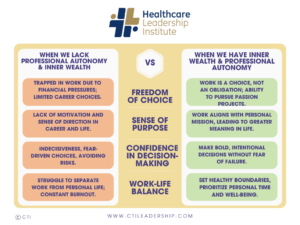
Behaviors When Lacking Professional Autonomy and Inner Wealth
Without inner wealth, it is easy to succumb to an unchecked inner critic. Do any of these scenarios, or corresponding quotes representing the critic’s negative self-talk, sound familiar?
1. Fear and Anxiety

- Constant worry about losing a job or source of income. “Someone else could take this all away.”
- Fear of speaking up or negotiating due to potential repercussions. “I would rather say nothing than deal with the repercussion.”
- Reluctance to take risks or pursue passions. “Don’t rock the boat.”
2. Overwork and Burnout
- Feeling trapped in toxic work environments. “I couldn’t possibly find something new.”
- Overcommitting to responsibilities out of fear of being replaced. “Nobody says ‘no’ to this type of assignment.”
- Neglecting personal needs and well-being in favor of job security. “I’ll start my self-care routine after this big project is done.”
3. Resentment and Frustration
- Resentment toward employers, clients, or projects that feel misaligned. “Why was this work assigned to my team?”
- Frustration over lack of control or direction in career decisions. “Why didn’t I know about that newly created position?”
- Cynicism about work and life in general. “Is this as good as it gets?”
4. Lack of Boundaries
- Difficulty saying no to unreasonable demands. “You don’t understand, this additional assignment is just part of the job.”
- Accepting work that doesn’t align with values or passions. “I don’t have a say in these assignments.”
- Sacrificing personal time and relationships for professional obligations. “Work has to come first.”
5. Reactive Decision-Making
- Making decisions based on immediate financial needs rather than long-term goals. “We don’t have time to worry about a long-range plan.”
- Being driven by external pressures rather than internal values. “I’m not good enough and if this assignment doesn’t go well everyone will know it.”
- Settling for less due to a lack of confidence or perceived options. “This must be all I deserve.”
6. Stagnation
- No time or energy to invest in personal growth or skill development. “There’s no time to reflect.”
- Feeling stuck in roles or industries that don’t inspire. “This whole industry is in trouble.”
- Limited ability to explore new opportunities or passions. “Why even try?”
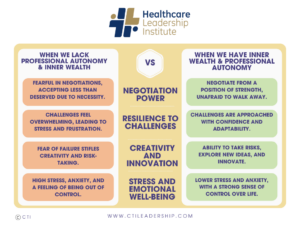
Benefits of Professional Autonomy and Inner Wealth
Inner wealth helps silences the inner critic. The scenarios (and quotes) below represent how inner wealth can reframe your professional life. 
1. Freedom of Choice
- Ability to decide whether, when, and how to work. “I’m only looking for projects that really match my interest and passion.”
- Flexibility to pursue meaningful projects and passions. “I have a choice to be or not to be engaged in this project.”
- Freedom to walk away from situations that don’t align with your values. “I can walk away from this project anytime and I can afford the consequences.”
2. Negotiation Power
- Confidence to negotiate from a position of strength. “If I need to walk away I can.”
- No fear of losing a job or opportunity because you have other options. “Let’s try it. If this does not work out, I have other options.”
- Focus on alignment with your goals rather than desperation. “This is worth my time.”
3. Resilience to Challenges
- Challenges are approached calmly and pragmatically. “I don’t have to stress and panic about this challenges, I can handle this.”
- No fear of failure because of a strong safety net and inner confidence. “An outcome won’t define me.”
- Ability to pivot and adapt without stress. “This seems like a great opportunity.”
4. Increased Satisfaction and Fulfillment
- Work feels purposeful and aligned with personal values. “I’m doing this because it’s important and I care about it.”
- Relationships are more meaningful due to reduced stress and more time. “We’re a team.”
- Greater sense of joy and contentment in life. “This is meaningful work, I enjoy ut.”
5. Enhanced Creativity and Innovation
- Freedom from financial pressures allows room for exploration and creativity. “I am not afraid to lose my job.”
- Risk-taking becomes less daunting, enabling innovation. “Taking calculated risks is part of an interesting career.”
- Opportunities to pursue hobbies and interests outside work. “My time is valuable, and I choose to spend it on what’s most important.”
6. Improved Mental and Emotional Well-being
- Reduced anxiety about the future. “Change is a feature, not a bug, of my professional life.”
- A strong sense of control over one’s life and career. “I am in control of my career and I can always make a change anytime.”
- Greater alignment between personal and professional lives. “This feels right. And if it stops feeling right, I will enjoy finding something new.”
Next Blog, we will address strategies on how to achieve inner wealth and professional confidence that include having a Clear Personal Line of Sight, Knowing your value, Building a Powerful Network, Hiring a Coach for Clarity and Accountability, Developing a Strong and Resilient Mindset
Understanding these benefits and behaviors can serve as a guide for assessing your current state and creating a roadmap toward professional autonomy and inner wealth. Identifying areas where you feel constrained and addressing them with strategic action can transform your career and life into one of freedom, fulfillment, and purpose.
Written by Jay MacGregor & Mo Kasti
Jay MacGregor, MD, MBA, MLS, FACS, is the Vice President of Medical Affairs for Allina Health (Minneapolis, MN). Dr. MacGregor is also the creator and co-director of the University of Colorado (Anschutz) School of Medicine’s longitudinal leadership curriculum. Prior to joining Allina Health Dr. MacGregor served in a variety of leadership roles in the Veterans Health Administration (VHA). He is the immediate past president of the North Dakota Chapter of the American College of Surgeons and is a member of the American College of Healthcare Executives. Dr. MacGregor is a Diplomat of the American College of Surgeons, the American College of Colorectal Surgeons, and a 2021 Dr. Richard L. Byyny Alpha Omega Alpha Fellow in Leadership.
Mo Kasti is a healthcare executive coach, leader and innovator. His passion centers around helping executives and clinical leaders elevate their thinking in times of transformation, leverage their team and organizational human dynamics to capitalize on innovative opportunities. When terrains are shifting, and outcomes are uncertain, Mo is uniquely equipped to help leaders see new possibilities (Second Curve). He is sought after for his expertise in transformational leadership, innovative strategies, and cultural transformation. With more than 40 years in business and healthcare, Mo is an expert in leadership, operations, culture and innovation.