



CHOOSE YOUR INDUSTRY:
Physician Burnout Assessment
Real Cost Of Physician Burnout
Beat Physician Burnout
What is physician burnout? Physician burnout is a state of physical and mental exhaustion caused by prolonged exposure to stress. Physician burnout can wreak havoc on your personal and professional life as stress causes you to become more cynical and detached from your work, family, and friends.
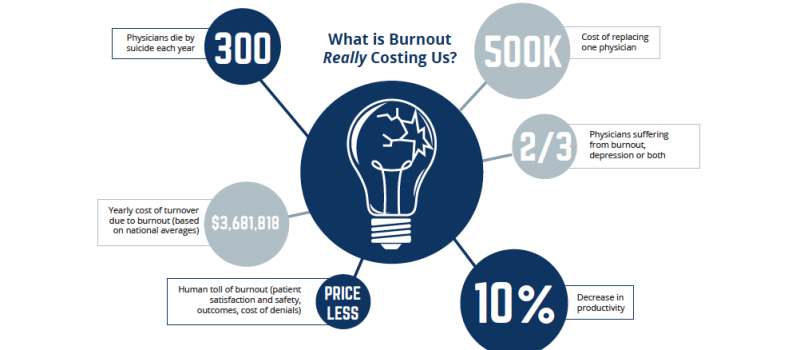
- 300 Physicians die by suicide each year
- The yearly cost of turnover in healthcare (based on national averages is $3,681,818
- The cost to replace one physician is 500K
- 2/3 of physicians are suffering from burnout, depression or both
- Burnout decreases physician productivity by 10%
Complete the Physician Burnout Assessment Tool
Our quick and easy Burnout Assessment Tool can help you determine if you are headed down the burnout path.
Upon completing the survey, you will receive a score that will help you determine where you fall on the burnout spectrum.
*All data will be kept strictly confidential. Only aggregate Burnout data will be used for market studies


Check Out This Playbook:
$
36818210
Yearly Cost of Turnover Due to Burnout
$
5000
KCost of Replacing One Physician
3000
Physicians Die by Suicide Each Year
It would be easy to put the impetus on the individual alone to remedy the problem, but it’s important to remember that the physician is only one part of a more complicated healthcare ecosystem. There are many cultural and organizational factors at play.
Physician
BURNOUT
To take our assessment, click here to be taken to the Burnout Assessment Tool.
Burnout Assessment Tool

100000
successful
Trainings
50000
Graduates
2000
+Facilitators
160
+Years
of Experience
testimonials
What People Are Saying About Us
The partnership between The Iowa Clinic and the Physician Leadership Institute has provided us with an educational foundation for our physicians to meet the business challenges in today’s changing environment. Their experiential approach has allowed a unique connection to how the physicians can immediately apply leadership concepts into their professional and daily lives.

C. Edward Brown
CEO, The Iowa ClinicHLI (CTI) and its Physician Leadership Institute had a significant and positive impact on our physicians. Not only did they learn essential leadership skills, but also how to collaborate with others and think strategically, they were able to apply those skills immediately to projects that addressed important, real-world objectives for our health system!

Kim Miller
FACHE, CEO, Beaver Dam Community HospitalI can’t say enough about HLI's (CTI’s) Leadership Fellowship! The lectures were relevant and engaging and the exercises really drove the lessons home. The opportunity to complete a 360 evaluation and have a personal coach make this far better than other conferences and classes I have attended. If you’re given the chance to participate, don’t hesitate. It’s well worth the time. You’ll learn about leadership; you’ll learn even more about yourself.

Mary Beth Hines
DO, CMO, UP Health System PortageI feel that the program has not only made me a better leader, but also a better doctor, partner, husband, father and friend. I used to think that being a good surgeon was about doing surgery well and getting good outcomes. Now I know that I can only be a good surgeon by creating an environment of psychological safety in all of those around me. Teamwork has translated into improved safety of our patients and joy in our work. The Leadership Training was a transformative experience in my life.

Utpal Desai
MD, AdventHealth Daytona Beach


Causes of Physician Burnout
There are many causes of stress and burnout for physicians and medical providers. While lack of personal resilience may be one cause, we believe organizational well-being, including a culture of wellness, removing hassle factors and leadership, accounts for an overwhelming majority.
Hassle factors are a key source of stress and burnout in the healthcare industry. Some of the common hassle factors are lack of timely delivery of instrument to the OR, the number of steps to accomplish a critical task, lack of specialty support deemed necessary for specific service, or lack of communication between providers.
